The exhibition "Memory and Horizon" (Μνήμη και ορίζοντας) presents 30 tourist posters from the period 1929–1996, drawn from the collections of the National Historical Museum.
On Wednesday 21 October, at 20:00, the Radisson Blu Park Hotel Athens continues the events it has staged to celebrate 50 years since its founding, putting on a distinctive visual arts exhibition that links art with high-calibre hospitality and with the venue's enduring presence in Athens.
It is the hotel's management, working with art historian Eleni Athanasiou as curator, that presents this selection of 30 posters created for the Greek National Tourism Organisation (EOT) — pieces by important Greek artists that capture, through a range of painterly and graphic approaches, the manner in which Greece was projected abroad over the course of the 20th century.
The show will occupy the hotel's communal spaces until Sunday 17 January 2027. It forms part of the programme of activities for the hotel's 50th anniversary and confirms its steady dedication to promoting art and culture, while also underlining its particular role as one of Athens' emblematic settings of hospitality, where the cultural experience meets hotel tradition.
Set within the tribute "Contemporary Greek Art", this exhibition is, in essence, also the history of an image: the image that Greece created of itself and sent out toward the world.
From 1929 through the mid-1990s, the tourist poster was never a mere tool for promoting a destination. It was, above everything else, a medium of visual narration. In a single picture, history, archaeology, the landscape, the light, the sea, architecture and everyday life could coexist — and, in the end, the very Idea of Greece. That layered portrait still shapes how people imagine a trip today, whether they are mapping out island itineraries or following a culinary journey through Greece to taste the authentic flavors of the table.
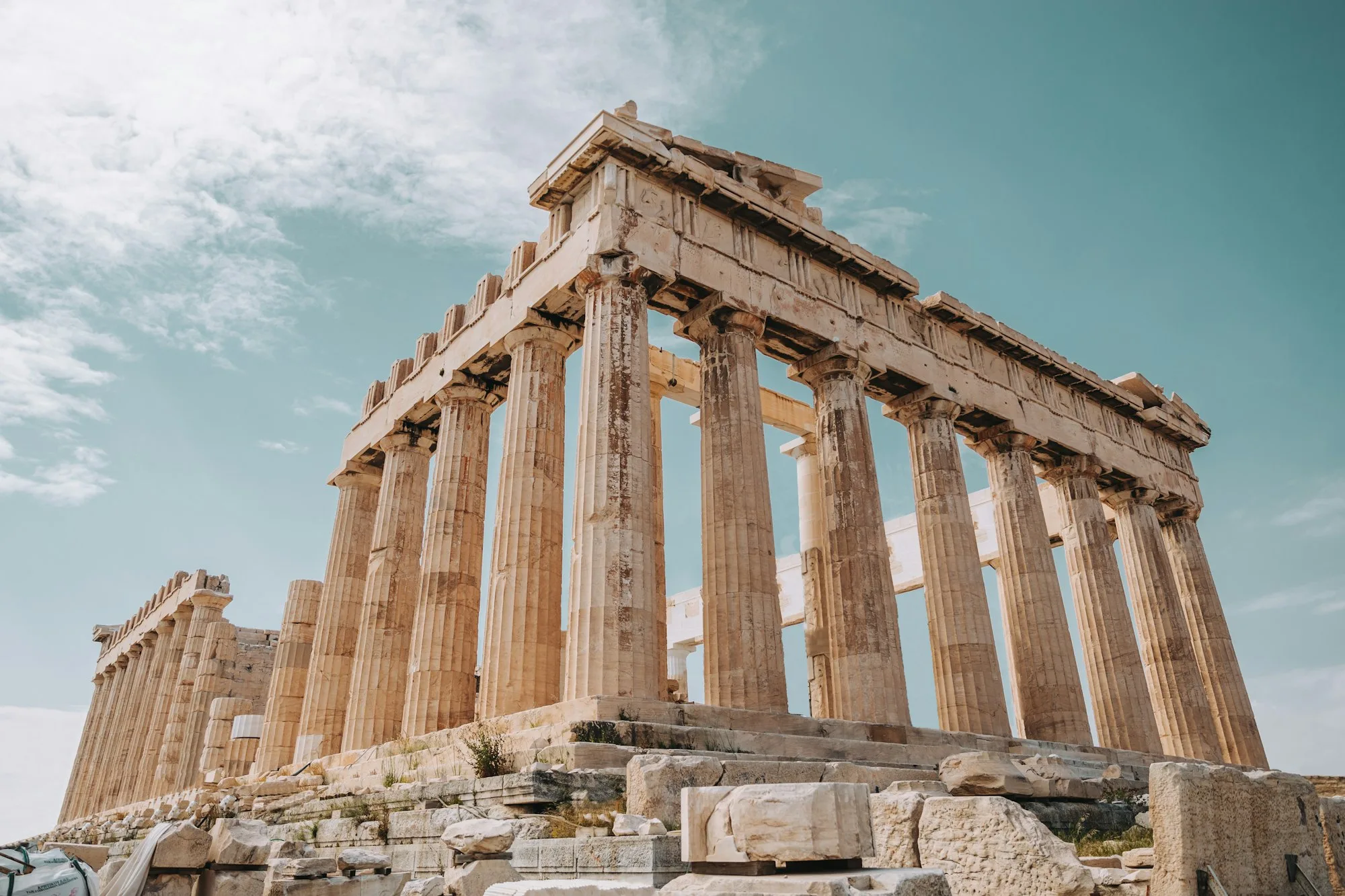
Already in the very first period, which opens in 1929, the country chooses to introduce itself through one of its strongest symbols: the Parthenon. Nelly's dated photographic poster "Athens – Parthenon", carrying French text, addresses an international audience from the outset and stands as one of the most characteristic testimonies of this early effort. From the first phase of organised tourism promotion onward, Greece presents itself not merely as a geographical location but as a cultural idea.
Major painters and creators take part in shaping the tourist image of the country. Among them figure Perikles Vyzantios, Panagiotis Tetsis, Yiannis Moralis, Spyros Vassiliou, Nikos Hadjikyriakos-Ghikas, Giorgos Vakirtzis and Yiannis Tsarouchis, alongside many more, while the contribution of designers, lithographers and photographers is equally decisive. Each of them, through a personal painterly idiom, helps form a new optical identity for Greece. The 1948 pairing of Vyzantios's "GRECE – Islands of the Aegean, an anchorage" and Tetsis's "GREECE – Coast in the Aegean", both printed by Aspioti-ELKA, shows how early the sea entered this self-portrait: decades before travellers began searching out the most enchanting hidden beaches in Greece to visit in summer, quiet Aegean moorings were already travelling abroad as painted promises.
After the Second World War and the re-establishment of the EOT in 1950, the Athens & Epidaurus Festival is founded in 1955 within the framework of postwar cultural and tourism policy. The institution connects the country's ancient heritage with contemporary artistic creation and acquires an international orientation from very early on. Its enduring story reaches into the selection through the 1976 poster for the Festival of Epidaurus, executed with artistic and graphic supervision by K. Vittou and printed by Atlantis M. Pechlivanidis & Co.
The 1960s constitute, perhaps, the supreme moment in the history of the tourist poster. It is the period in which Greek graphic design establishes a clear and recognisable visual language, one that converses with the international currents of modernism. At the centre of this renewal stand Michalis Katzourakis, Fready Carabott and Agni Katzouraki — figures tied to one of the most significant chapters in the history of Greek graphic design and advertising communication. The tourist poster takes on an international vocabulary built on clean lines, geometric forms, abstraction, a love of the void and strong chromatic contrasts. Without imitating the prevailing international styles, Greece manages to shape a contemporary visual identity of its own. The 1967 "GRECE – Corfu" poster, carried out under the artistic and graphic supervision of V. Laskas and printed by Technographika, slots neatly into this peak period.
As the decades roll on, the aesthetics shift. Photography acquires ever greater weight, graphic design evolves, printing technologies transform what the image can achieve, and advertising grows progressively more intricate. Despite the changes, certain motifs remain constant. What alters is the way in which these elements are arranged and endowed with meaning.
In the 1990s, television, the internet and digital media reshape in radical ways how the image is produced, distributed and received. Today, the characteristic, primarily vertical format — for decades one of the country's principal instruments of promotion — has been transformed into a valuable historical document, and with it a long cycle is, in essence, brought to completion.
As art historian and exhibition curator Eleni Athanasiou observes, viewed as a whole, the course from 1929 to 1996 reveals that the story of the tourist poster is one of ceaseless transformations. Behind all of these shifts, however, something remains constant: the need to narrate Greece, to render it visible and recognisable — and perhaps, in the end, to understand it ourselves. Standing before these posters today, she notes, we do not see only an advertising image of a bygone era; we see a gaze — the gaze of a country upon itself. In the same spirit, she describes the National Historical Museum's collection as something beyond a backward glance at poster history: a passage through the successive versions of Greek identity.
The exhibition will be inaugurated by the Minister of Tourism, Olga Kefalogianni.
About Hotel Mediterraneo • Chora, Ios
We are a boutique hotel in Chora, Ios Island, Greece. Our team is passionate about sharing the authentic beauty, culinary traditions, and stories of the Cyclades with guests from around the globe.
Explore Hotel & Accommodations

